
BLOG | February 2, 2026
License Management and NIS2 in Austria: Your Guide

Stefan Pfeiffer
Sales
Introduction
October 1, 2026, is fast approaching, and this is a date you should mark on your calendar. On this day, the new Network and Information Systems Security Act (NISG 2026) will take effect in Austria. However, this is not just another IT regulation, but a fundamental realignment of responsibilities for cybersecurity.
The biggest hurdle? Around 4.000 Austrian companies are directly affected, but many are still unsure how they are even supposed to meet these rather far-reaching requirements
This guide explains the core requirements of NIS2-Directive and highlights the often-overlooked but crucial role that professional license management plays in connecting NIS2 in Austria to ensure true compliance.

The Basics: What Does the NIS2 Directive Mean for Businesses in Austria?
Simply put, NIS2 is an EU-wide directive designed to strengthen cybersecurity in 18 critical sectors across Europe. In Austria, this directive is implemented by the NISG 2026 (Network and Information System Security Act 2026), which will apply to all affected companies starting October 1, 2026.
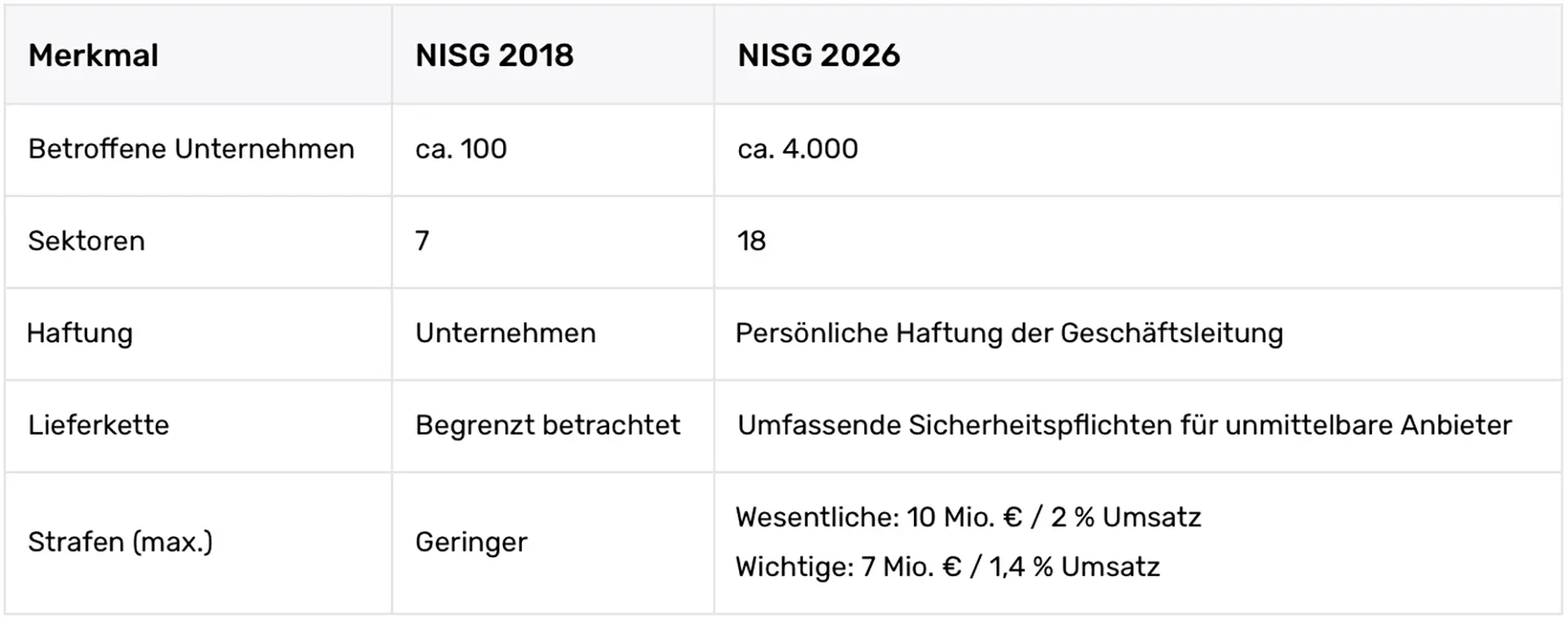
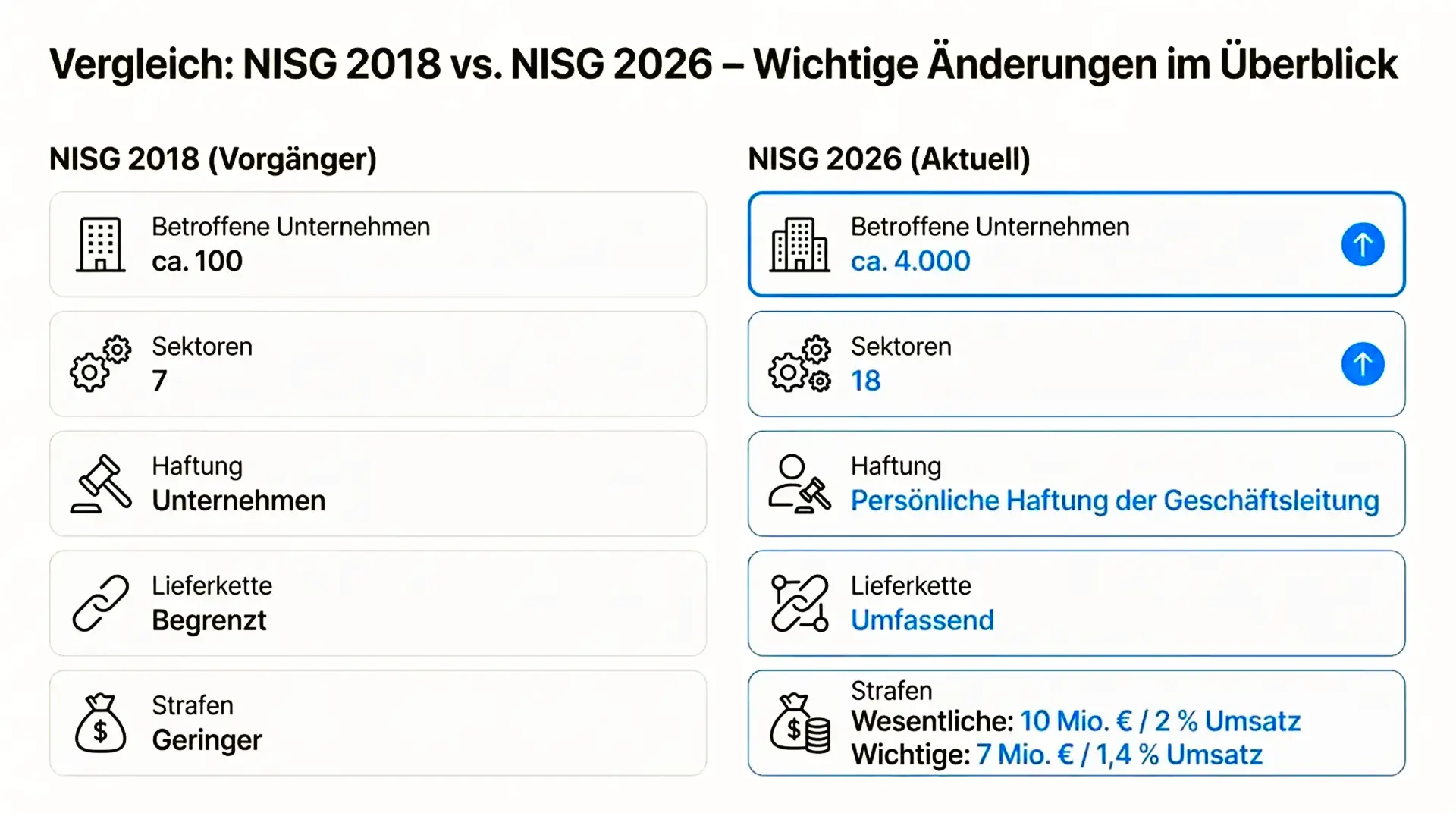
So who exactly is affected? Mainly medium-sized and large companies in the defined sectors. And that’s a huge jump: While the old NISG 2018 affected only about 100 companies, the number has now risen to around 4.000. Incidentally, all companies falling under this scope must register by December 31, 2026.
The directive distinguishes between “essential” and “important” facilities. The classification depends on the size of the company and the criticality of the sector. The main difference lies in the type of oversight (proactive for essential entities, reactive for important ones) and, of course, in the severity of the penalties for noncompliance.
Ein Vergleich verdeutlicht die Änderungen:
The Core Requirements of the NIS2 Directive
The NIS2 Directive is not purely an IT issue that can simply be passed on to the IT department. It touches on the very core of corporate risk management and places direct responsibility on senior management. Let’s take a closer look at the three most important pillars.
Cybersecurity Incident Response
NIS2 requires a comprehensive “all-hazards approach.” This means looking beyond the scope of traditional IT security. According to the overview provided by the Austrian Chamber of Commerce (WKO) , companies must implement a wide range of measures, including:
- Cybersecurity Incident Response
You need established processes to prevent attacks, detect them quickly, and respond to them. - Business Continuity
What happens if something does go wrong? Plans for backup management, disaster recovery, and crisis management are mandatory. - Supply chain security
You must assess and manage the risks posed by your direct suppliers and service providers, such as software vendors. - Cybersecurity hygiene and training
Basic security practices and mandatory cybersecurity training for all employees and management are no longer just optional. - Access Control and Encryption
Clear policies for personnel security, access rights, and the use of cryptography are required. This also includes an explicit requirement for multi-factor authentication (MFA).
Strict Reporting Requirements for Security Incidents
When a serious security incident occurs, the clock starts ticking. NIS2 mandates a multi-stage reporting process to the responsible CSIRT (Computer Security Incident Response Team), such as CERT.at:
- Within 24 hours:
An initial early warning must be issued. In many cases, it is sufficient to simply report a suspicion of an illegal act. - Within 72 hours:
The report becomes more detailed. An initial assessment of the severity, the impact, and so-called indicators of compromise is required. - No later than one month after the report:
A final report must be submitted. It must include a detailed description of the incident, an analysis of the causes, and the corrective measures taken.
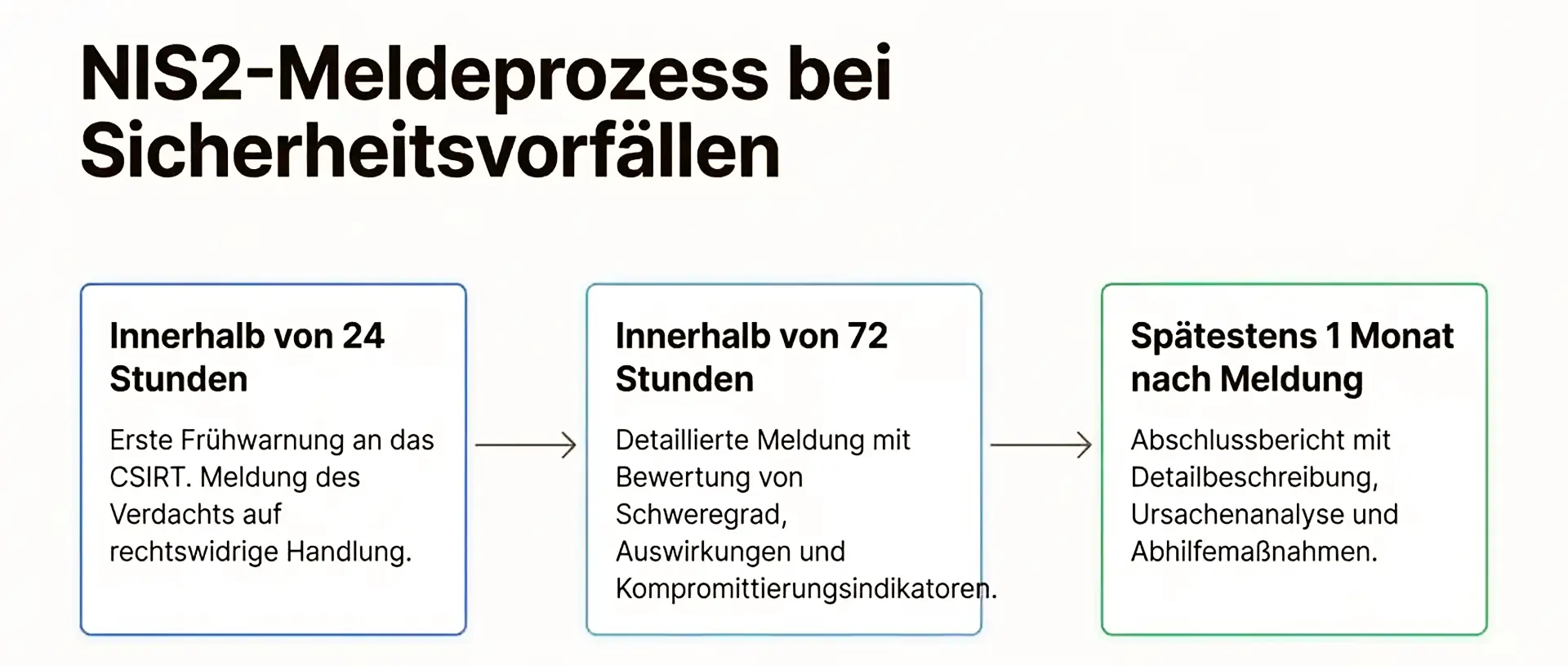
This tight schedule puts enormous pressure on internal processes and makes a well-thought-out and, above all, proven contingency plan essential.
Personal Liability of Management
A key change is the introduction of personal liability for management bodies. Managing directors and board members must not only rubber-stamp and approve cybersecurity measures but also actively monitor their implementation, and they are personally liable for doing so .
What does this mean exactly? Not only does the company face substantial fines, but management can also be held personally accountable and, in the worst-case scenario, even be temporarily barred from holding executive positions. To fulfill this responsibility, managing directors and board members are even required to participate in specialized cybersecurity training.
The Critical Connection: License Management and NIS2
What does all this have to do with license management? More than you might think at first glance. The key point is this: You can only protect what you know, and you can only be accountable for what is documented.
A Comprehensive Software Inventory as a Foundation
One of the most fundamental requirements for effective risk management under NIS2 is knowing every single piece of software running on the network. Without a complete inventory, measures such as vulnerability management or access control are practically impossible.
This is where the major problem of shadow IT comes into play: unauthorized software or SaaS subscriptions that departments acquire without the IT department’s knowledge. These uncontrolled applications create massive security gaps and compliance risks, thereby undermining the principles of NIS2 at their core.
Professional Software Asset Management (SAM) is the only reliable way to create and maintain a complete and accurate inventory of all IT assets. It is the foundation of any serious cybersecurity strategy. Independent specialists such as LYYNX offer precisely this fundamental transparency as a managed service through their License Management Service (LMS), thereby laying the groundwork for a successful NIS2 implementation.
Vulnerability Management and Supply Chain Security
Once you have a complete software inventory, you can use it directly for vulnerability management. You can track versions, identify outdated and unpatched applications, and thereby meet a key technical requirement of NIS2.
At the same time, software vendors are a key part of the supply chain. NIS2 requires that the risks posed by these vendors be actively managed. Proper license management inherently involves the administration of contracts, usage rights, and vendor relationships, which directly contributes to the required supply chain security.
Quote from Lambert Huber: “A well-managed license inventory not only ensures compliance with vendors but also serves as crucial evidence for NIS2 audits that you have control over your software landscape.”
Audit Readiness and Traceability
Compliance with NIS2 is verified by the competent authority, the new Federal Office for Cybersecurity . In the event of an audit, you must be able to prove that you have done your due diligence.
A well-documented SAM or LMS process provides exactly this evidence. Reports on the software inventory, patch status, or usage data are crucial for demonstrating compliance. An independent partner like LYYNX Consulting helps you prepare all supporting documentation properly and ensure data quality. This makes your company “audit-ready” not only for software audits but also for inspections by NIS2 authorities.
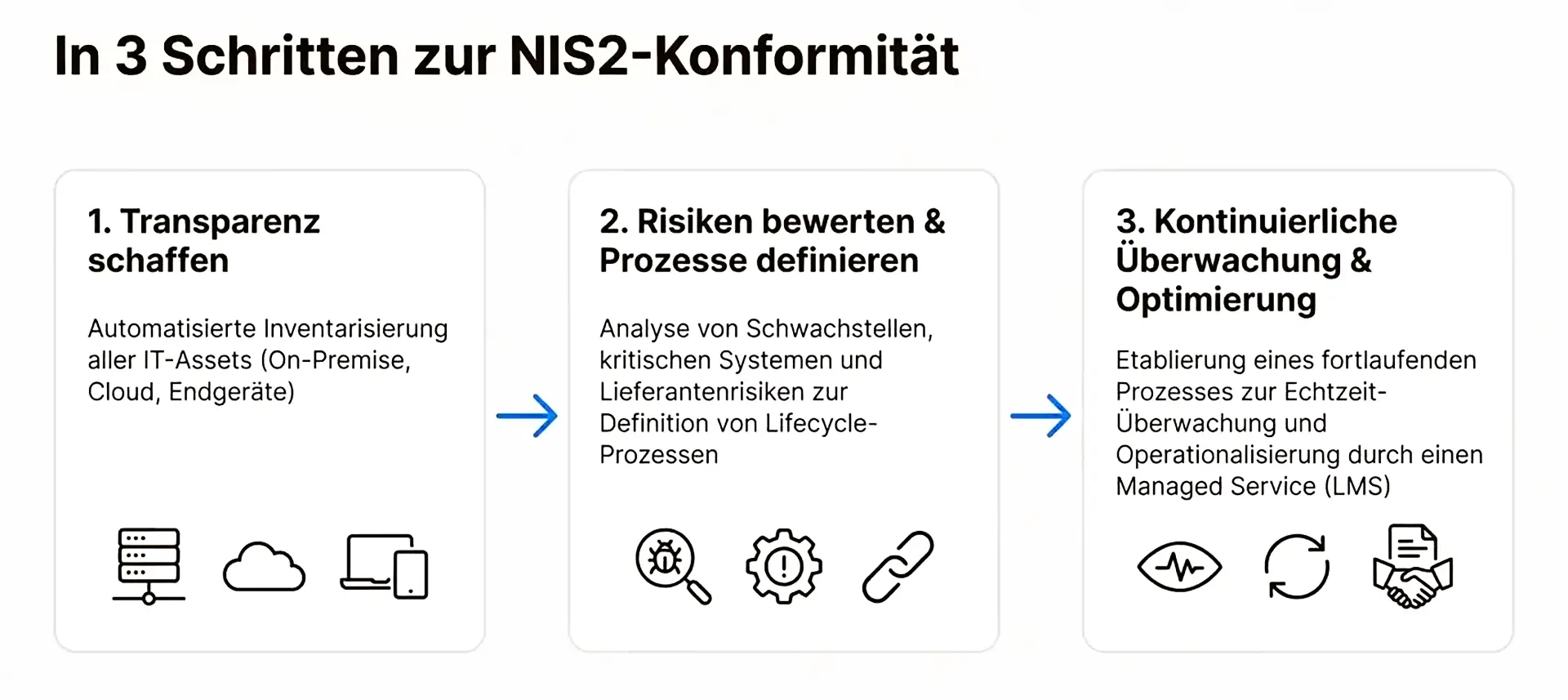
3 Steps to NIS2 Compliance
Here are three concrete steps to help you achieve NIS2 compliance through better license management.
Step 1: Create Transparency:
Asset Inventory and Analysis
It all starts with gaining a complete, automated overview of your entire IT landscape. This includes on-premises software, cloud services (IaaS, PaaS, SaaS), and all endpoints.
Manual lists, such as those in Excel, are often prone to errors and quickly become outdated. Instead, use specialized SAM tools like Flexera or Snow to automate this process. However, the correct implementation and configuration of these tools requires a significant amount of expertise. As a certified Flexera Advisor Partner, LYYNX Consulting ensures that your data foundation is accurate and reliable from the very beginning.
Step 2: Assess Risks and Define Processes
Once you have achieved transparency, you can begin to assess the risks based on the new data. Ask yourself the following questions:
- Which software is outdated and has known vulnerabilities?
- Which systems are absolutely critical to business operations?
- Which software vendors pose a high risk to our supply chain?
Based on these answers, you can define clear processes for software lifecycle management—from procurement through deployment to decommissioning. This will help you prevent future security vulnerabilities and the emergence of new shadow IT.
Step 3: Establish Continuous Monitoring and Optimization
NIS2 compliance is not a one-time project that you can simply check off your list. It is an ongoing process and must become an integral part of your company’s daily operations.
This means you need continuous monitoring of your IT environment to detect new software, changes in usage, and emerging security threats in real time. This is precisely where a managed service offers its greatest advantage, as it ensures the process is sustainable without tying up excessive internal resources.
A managed License Management Service (LMS) like the one offered by LYYNX operationalizes this entire cycle - from inventory and risk assessment to continuous monitoring and reporting. This ensures sustainable compliance and security without requiring you to manage it on a daily basis.
The path to NIS2 compliance may seem complex, but there are many resources available to shed light on the process. To better understand the regulatory requirements and practical steps for businesses, the following video offers a helpful overview of current challenges and solutions in the area of compliance.
This video provides an overview of the growing regulatory requirements, such as DORA, the AI Act, and NIS2, and shows how companies can prepare for them.
NIS2 as an Opportunity for a Secure and Efficient Future
Yes, NIS2 is a legal requirement with severe penalties. But it is also a huge opportunity for Austrian companies to finally gain full control over their IT, drastically reduce security risks, and optimize costs at the same time.
Effective software license management is not merely a side task but a central pillar of successful NIS2 compliance. Companies that act now will not only avoid penalties but also build a more resilient and competitive organization. They’ll turn a regulatory obligation into a strategic advantage.
The regulatory landscape is complex, but you don’t have to navigate it alone. If you’d like to know how your current license management measures up to NIS2 requirements, schedule a no-obligation consultation with us—the vendor-neutral experts at LYYNX Consulting.
We’ll show you how to achieve clarity, security, and compliance.
Frequently Asked Questions
What is the biggest challenge in implementing NIS2 in Austria?
The biggest challenge is often the lack of transparency across the entire IT landscape. Without a complete and up-to-date software inventory, it is impossible to assess risks, manage vulnerabilities, or ensure supply chain security—all of which are core requirements of NIS2.
Who is responsible for NIS2 within a company in Austria?
Senior management bears personal and ultimate responsibility. NIS2 requires managing directors and board members to actively oversee the implementation of cybersecurity measures. However, operational implementation is a cross-departmental task involving IT, procurement, legal, and management.
How does an external service provider like LYYNX help with NIS2 compliance?
An independent specialist like LYYNX Consulting establishes the data foundation for NIS2 compliance. Through a managed service such as the License Management Service (LMS), a comprehensive software inventory is created and continuously monitored. This provides the necessary evidence for audits and helps proactively manage risks.
When must the NIS2 requirements be met in Austria?
The relevant law (NISG 2026) takes effect on October 1, 2026. Affected companies must register with the competent authority by December 31, 2026, and comply with the requirements as of the effective date.
What penalties apply for non-compliance with NIS2 regulations?
The penalties are substantial and tiered. For “critical” entities, they can amount to up to 10 million Euros or 2% of global annual revenue. For “important” entities, the fines are up to 7 million Euros or 1.4% of revenue. In addition, senior management is personally liable.
Is NIS2 just an issue for the IT department?
No, absolutely not. While the IT department plays a central role in the technical implementation, NIS2 is a strategic issue for the entire company. Due to personal liability and the far-reaching requirements for risk management, it is an issue that falls directly under the purview of senior management.
Start now with a no-obligation initial consultation – and gain clarity on the actual optimization potential of your license portfolio..
Get the latest news delivered straight to your inbox – subscribe to our newsletter now!
Stefan Pfeiffer
Sales